Thursday, May 29, 2008

Seira Pomodoro

Just some pictures of Pomodoros sculptures, about finding a complex inner form when the outer form suggest something entirly different ... A new form being founded within the chaos of an outer form. His Spheres are called Sphere Perforations


Tuesday, May 27, 2008

Final Composition


Final Photos to Form Final Composition

Each photograph is a process of a system to represent movement, each adds to the experience of movement through different mediums.
This first Photo shows in close up detail the movement being mapped on the 2D, then as it branches out beyond the board
, Two maps here; One is Paris ariel view and the other is a map of hireachy, which points are allowd to match up, where the large streets stopped, they were branched off to the other map.

This photo Branches the 2D movement into the 3D. The large shapes begining to form are city blocks as they are suspended between the roads in space

The 3D mapped movement model placed on the google earth image of Paris.


Detail of the
water falling down the model, here the wire 3D roads are the paths of movement as
the water falls along

This detail shows the shadow play and the next photo shows the sequence of that process to get the shadows as the light source moves over the movement map. Here the wire roads stop movement, light passes around the wire while the wire hinders it.


This sequence shows the movement through this 3 Dimensional space. The light moves through the 3D map modelling movement of a more complex nature the simple "Birds eye view Observation" and point plotting, it observes the new movement and argues hirarachey of space and occupation, where does or doesn't the light reach? where can or can't we move?

Sunday, May 25, 2008

Composition Process

This is the Compositional model made for the final project, started off with a few maps of Paris from Google earth on seperate walls, then connecting up the major streets, it starts off being held with masking tape just because it was hard making it all connect in the right way without it falling down but i didn't want unnecessary complication ... so yeah, it was annoying.


Saturday, May 24, 2008

Assignment Three

Direction, Movement, Change

All refferenced MLA stly in the essay 9th June

Keyword and sketching... Moving it into aspects, developing.
What kind of marks can it make?

Media - Control of the line, constraint, running out of ink { Minalmilistic
- Photography. Meanings and perspectives asscociated, experiment with different media
-Light and Shadow.
- Video of spatial experience
- Small model? Or instilation?
-Water, movement Different Marks.
- Fire.

Future

Hopefully we have deepened our knowledge of the past to better our decisions of the future.

Predict the future through patterns of the past: Design motif

"The Best way to predict the future is to invent it"
Allen Key

Robotics:
Took decades of engineering to create a robot that could move on two legs. Word Origin:
1920's Factory that produced artificial people, called robbots.
"Robot" in Chekoslavakian means to force labour.
Leonado De Vinci - First robots: He was the first to contemplate the idea of the robot.

MIT's 2007 annual robotics engineering competition.

"Suvival Research Labs"
SLR Art proformances by robots, industrial robot fights. They have been made ledgenary by such free invitation proformances, as in if you invite SLR they will come and preform for free. Over the years their proformances have grown more violent as the robots have gotten more sophisticated.


Robotlab
Jukebot
- They study the relationsip between robots and people. More common robots are the industrial robots, of which there are literally millions, however they are rarely found in public spaces, usally only foound in industrial places.

They Argue that because of this, people have not assesed their own relationship with robots and they want more robots in public spaces.
"bios [Bible]"
2007
- A robot wrote out the entire bible by hand in ink pen, uninterupted. - High precision of text! Script writting.
Stalrac
"Third Arm"
1981 We never had a mind of our own, our bodies are manipulators.
The Tissue Culture as Art project. "dissembodied Cusine" www.tca .uwa.edu.au. Frog steak, Do we need to kill animales to eat them?
Seems like science teachers trying to pass off math as art when art is the emotional side, they just can't mix!
Eduardo Kac - "Alba"
Flourescent Bunny, now that we can create life like this, how will we deal with it?
Maray Shelly (Frankenstein 1818)
Jules Verne (journey to the centre of the earth 1864)
H G Wells (War of the Worlds 1898)
Issac Asimoue (I, Robot 1950)
2001 A Space Odessey (1968)
- Robots taking over, Turning Evil and killing. Popular Idea up to the 1980's; Yet now robots are smarter, instead of simply killing people, they infiltrait them, with the goal of genocide of the entire human race, Battle Star Galactica.
Star Trek, We copy ideas from it (Palm sized communicators ...)
"Any sufficiently sophisticated technology is indistinguishable from magic"
Authur C. Clark

Thursday, May 22, 2008

Paris Maps

Paris maps as chosen city to build up 3D movement


Tuesday, May 20, 2008

Early Model

These are the early model of what it could posible, or posibly not! look like, this is just taken from building fake streets in the air. After building this was looking at what movement to map... Looked at cities and decided Paris would do suitably. It looks like a giant network of connecting steets, the streets are perfect molds for the mapping of movement through a city as the bigger the streets the more movement through it.

Monday, May 19, 2008

Experiments

Movement

I was starting to look at movement of a city! As design can drive the direction of City, and exspecially at a time of Crisis.
During an Urban Design lecture they showed us time lapse drawings of Palmerston North every 12 years dating back to 1912, showing the spead of buildings and the city itself. This reminds me of Archigram and the idea of walking Cities, but our cities are moving, so could I build a 3D form of this movement?

Mediums
Fire leaves a lasting mark, yet it in itself is never a solid form, always moving and spreading.
Shadow and light
Spraypaint

Sunday, May 18, 2008

Ecology of the Artificial

The moral responsibility of the designer; "There are few professions as harmful as Industrial design"

Ecolologically sustainable design

  • The Ecosphere [earth]
  • Atmostphere [Air]
  • Biosphere [Life] } A Limited Evironment
  • Lithosphere [Rock]
  • Hydrosphere [Water]

Easter Island Example

Stone Statues on the coast.

Europeons arrived and found barren wasteland

The inhabitants chopped down all the palms to make ropes and transport the newly created statues to the coast. The last statue was erected and the last palm cut down. But the main source of food was fish, but without the wood to make canoes there was no more fishing, so soon the inhabitants decended into chaos. Civil war erupted and the natives turned to canabilism. 90 percent of the population was killed off.

This storey shows how a comparitivily primitive peoples with primitive technology was able to destroy themselves.

As designers this raises te question of "What was the persons thoughts as he cut down the last Palm Tree?" did he think somehow more would appear?

Redistribution of materials, taking more from the biosphere and dumping it back into the earth. Product Life Cycle: -> Design Concept -> Materials and Manufature -> Packaging and Transport -> Consumer Marketing -> Consumer Use -> End Of Life ->

The transition from 'Green Design' to an ecological model of the artificial.

Deconstructivist Architecture.

  • Frank Gehry - Gehry House
  • Our world has changed - So our architecture should reflect that.

Green Design

Ethics. eg Energy saving 'sleep' function. We added on an energy sleep mode to the computer, which is a plus, but then we feel ok about leaving the computer on the whole time.

Ecologically Sustainable Design

Instead of throwing away computers for a faster one, just replace the part you need. An extreme example for this is a tyre puncture, don't throw away the tyre, just repair the puncture.

Saturday, May 17, 2008

Internet Reading


Unfortunatly i can't read my own notes on this page. My handwriting is very bad. So i just took a photo of the page.

Keyword

Movement

My Essay is about the new designs of the early 20th Century being the driving forces of nations, Modernism driving the West, and constructivist art and architecture driving Russia to abandond the old and completley review all concepts of definition.

Therfore the driving words behind Movement are direction, nation, new and change.

Friday, May 16, 2008

Social Dimensions of Wearable Computers

Dragon technology, speaking to a computer; New Zealanders tend to mumble words compared to other English speaking countries. Having background music may distort readings.

Computers that will read hand movements or body movements; readings will be distorted as something unpredicted enters the area; A Child is playing in the background.

Jackets with iPods in them, but what do you do when it becomes too hot to wear the jacket; no iPod?

Watches should be adaptable to do what we do, along with other such gadgets. Watches should withstand more, not be precious commodities.

Wearable computers as a means of control.

  • Monitoring, Imbedded chips,
  • Cameras Tracking devices
  • Behavioural Monitoring devices, such as for use in prisons

Privacy issues

  • Big Brother
Steve Mann is a leading inventor of the wearable computers

Tuesday, May 13, 2008

Lecture on Technolgy

  • Consumerism as a weapon against Communism.
  • Consumerism as a distraction.
  • Aluminium the material of the war. Houses were built more like military houses.

We can change and rearrange the house as a plaything.
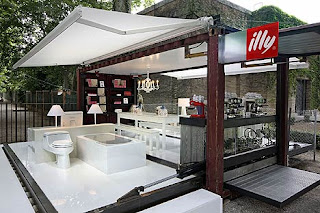


The Push Button House [It starts off as an ordinary shipping container, but throw a switch and ninety seconds later the Illy Push Button House has magically expanded into a five-room abode. Architect and designer Adam Kalkin created this jack-in-the-box-like dwelling, whose sections are unfolded by powerful hydraulic cylinders controlled by a computer in the kitchen section. The house is made out of recycled materials, and has a dining area in the centre, surrounded by a bedroom, living room, library and kitchen. This mechanized hydraulic contraption is on display now at New York's Time Warner Centre until December 29th, in hopes of demonstrating how prefabricated houses can be placed in, say, a disaster area and quickly assembled in a matter of seconds. Now if Kalkin could just figure out how to include a roof in this design, we think he might be onto something.]
A house made from a shipping container. The Wife can control the house at the push of a button from the kitchen.

Objects produced that we don't actually need, i.e. Fluoride in water, do we actually need it? Or an electric tooth brush as opposed to a normal one?

The Car is like a moving home, treating it like a living space.
TV screen as our Window into the World, but it isn't because its actually artificial, and yet people treat it as such.
Drive Throughs.
Americas strength is compared to how many appliances they have, not how many Nucleor Weapons they have.

DIY multi talent embrace of technology.

Graphic Digital Artist; Romoki
People need to get away from buying completely useless stuff.
- “Why do we need to mess with electronic devices and call it art?”
Romoki designed objects that have no use and provide minimal entertainment.
Taking consumer products and presenting them as art in a different context, i.e. Cell phone converted into a toy racing car. Taking old consumer products people put too much emphasis into and turn it into art.

Open sourced software.
- Human readable code is distributed freely to anyone who wants to modify it

Tuesday, May 6, 2008

Criticality of Art Design

Ren Koolhaus

"Peirecing analogues apparently incongrous ideas and creating something industrial"

Richard hamilton, Marcel Duchamp - Representing ideas as art. presenting something in a different way i.e.

Andy Warhole - Campell Soup

Frank Gehry

Drooy Design

Salvador Dali

Sex Pistols - Punk

Gorden Matta-Clark - Creating Voids through the buildings, making cuts in the unodorned buildings to show beauty.


Friday, May 2, 2008

Networks


About horozontal, charcterised by flat space, or infinite space. British group of Paper Architects [Paper Architects produce work that is not built but more a political proposal] called Archigram; 1960's


-Their ideas included plug in cities that were mobile, and entire cities that were moveable as if they walked, a city that was more like a network of connections. it was more like utopian idea.


New Babelon; 1969


Archizoom; 1969 - Non stop city ( A plan that looks like a circuit board).

When the city becomes a circuit, a moving network. Users contribute to the design, many people adding a small peice, adds to the whole project.


Superstudio; 1969
- Architectural model for urbanisation


Wikipedia
- Open sourced network.

Wednesday, April 30, 2008

Binary Opposition


Post modernism, opposition of made form. Post modernism made awareness of 'other' disabled access. To design in the 1950's: Richard Hamilton: Just what is it that makes today’s houses so different; 1956 Pop art; Art is for the masses! "Magnifying glass" 1962 1970: Abstract Expressionism; painting about how one felt at the time he painted it. Hippy movement, design, music, clothing. In the 60's society stopped needing and started wanting. Needs vs. Wants. Explosion of mass consumerism.

Moon landing, Sparked allot of 'moon design' i.e. TV’s shaped like helmets, futuristic "space looking design"

Ettore Sottsass, Started Memphis movement, highly post modernism. No innovation in time at crisis

No innovation in a time of crisis as there is any money to buy. [1971 Nixon suspended conversion of U.S dollar into gold]

Paris [1968] - Student uprising, the students did not like what they were being taught and by who, so they started protest which led to riots and many arrest but finally they were able to choose their lecturers


Post Modernity Building


X Y Z Buildings, Alienating with its mirror glass "Curtain" Walls which don't allow passer bys to look in yet they don't know if they are being watched...

Robert Taylor Homes
Chicago Housing Authority 1964, His buildings turned into slums, housing drug addicts and crime, which eventually turned into murder...
Therefore his buildings were demolished.


Le Corbusier wanted streets within the levels of the buildings, yet on hindsight we can see this created slums as these streets could not possibly police all the streets.

The Architects' dream 2001, Collage, VSBA Rutter Thomas Cole, demonstrates principals from Learning Las Vegas, Learn from what is on the highway. A building with a sign sells what the sign says, it doesn't matter what the building looks like. Poetics of space

Structuralism

- Levi strauss. Foucault Lucan, Bathes

Word is meaningless, it is just association, and post modernism is only significant.

Tuesday, April 22, 2008

Essay Draft

When society needs to be rebuilt on new principals a visual aspect is used to drive the thinking of the ‘new’, a call for this can happens due to wars or changes in government, WWI and the Russian Revolution of 1917 were events that largely influenced innovative design in the early-mid 20th Century, when a new art is called upon to reflect the new direction, and Design, as creative problem solving evolves due to and is used as a propaganda tool for conflict and war. WWI was a time people never wanted to return to, so a new design was used to reflect this new ‘rational’ society. The reaction to WWI was the ‘new’, the modernist movement, driven by architects such as Alter Gropius and Le Corbusier. The Russian Revolution of 1917 was a time when the old Tsarist regime was overthrown and all the ‘old ways’ were tossed aside to create free country, a new art was used to express the direction of the new communist government, one of dynamism, direction and power; Constructivism, founded by Kasimir Malevich by works like Black Square and Red Square and driven by such as Vladimir Tatlin.

Many designers and architects saw WWI was a loss of rationalization, where people simply ‘lost their heads’ which they thought may have been attributed to the common style of the time, with a largely ornamented style of pointless decoration full of eclecticism that cluttered and complicated the life of the working man. Therefore they wanted to change the way of thinking through design, and to wipe clean the slate of society and start anew, a ‘New Architecture’ expressed by Le Corbusier’s work Towards a New Architecture led by architects and Designers who tried to rationalize their art to create a more rational society, as they believed that a person could be changed by his surroundings. William Morris created Art Nouveau like flower designs for Wallpapers which he believed could create better morale people by creating better surroundingsThe Russian Revolution was symbolized by the murder of the Tsar, it was the murder of all the traditions of the Tsarist regime as well, the art was no longer for the rich to admire, Art was to be free, free from the burden of the object, free from the denotations of class, it would be integrated into the lives of all, including the working man. The architecture too was abandoned, it was now an architecture of direction, design without fruitless ornament or cluttering decoration, Art was stripped down to its basic geometric proportions, free from the object and expressed pure emotion of human nature, as constructivist artist Aleksandr Rodchenko demonstrated in his various illustrations where he dismissed ‘pure art’ for an art that became a social tool, widely used as propaganda by the new communist government. Vladimir Tatlin’s Proposal for the Monument to the Third International
Would pave the way for constructivism and set the mark for what constructivist would aim for, to pierce the heavens and strive for direction. Although like many early Soviet projects it never made it past the planning stage. Constructivism would break past the barriers and restrictions old, it was the ‘new’ that modernism was built on too, both had similar means but to different ends. Constructivism was to symbolise a new direction of their country and a new Government, Modernism was to reflect a rational society, free from such inhumane acts as war and was seen as a solution for poverty, although put in practise, some of Le Corbusier’s urban city designs created hotspots for poverty living in its; elevated internal streets. Maison Radieuse (Radiant City) was a complex that was pulled down after it became the slums of Rezé. William Morris’s designs for wallpapers, believing nicer spaces create nicer people, but there is still a lot of controversy about such philosophies.


Both containing roots in each other, Modernism and constructivism, were new, original, and at their time extremely radical due to the ideas they rejected and principals behind the design philosophy. These styles originated due to the reaction of a major conflict or huge social upheaval, they abandoned all the styles before them, no more borrowing from the past styles of eclectic decoration and ornament, both Russian Constructivism and Modernism looked only forward. Yet they were accepted because they were driven by a few leaders of the movements, Walter Gropius, Le Corbusier, and William Morris found themselves in a public spotlight as city planners and established designers, where their designs were getting out, and winning competitions and were controversy, were able to express the new movement and pave the way for modernism design. This group of fathers of Modernism wanted to steer society in their direction, they were shocked by the world war and wanted to fix society to avoid such a catastrophe again, which meant the old style of thought wasn’t working; it failed when WWI started, so something new was needed. Constructivism was a solution to another problem, but ultimately similar to modernism in that it rejected styles of the past, and aimed for a new direction, but the difference is, Constructivism symbolises the new direction, Modernism is what is being used to create the new direction.

True innovation arises from a problem. Design is creative problem solving, as when there is a conflict in society. It can be used to symbolise, direct and express using design for architecture, furniture, wallpaper and art, and reflects greatly the society it portrays, and greatly influences the mindset of that society. Design and architecture, as social tools and not pure art, adapt and reflect society to express meaning and significance, giving solutions to such social conflicts.

Bibliography: Cook Catherine, Fantasy and Construction, London, Architectural Design, AD Editions, 1984 Cook Catherine, Russian Constructivism & Iakov Chernikov, London, academy group, 1989 Corbusier, Le, Towards A New Architecture, (1923) Meuser, Phillip, New Revolution in Russian Architecture, Singapore, Page One, 2006 Saunders, Gill, Wallpaper in Interior Design, London, U&A, 2002

Thursday, March 20, 2008

Design and Postmodernity

Post Modernity - is everywhere, from literature, design and philosophy.

Modernity - Renaissance, Modernity because it is now.

Modernism was all about meaning, it had a value system.

- ities: Describe the whole system, that ideology.
- ism: Are the qualities associated with these ideals

Post modernity: State or ideology of being postmodern, 1950 - 1960's, late modernism (or early Post Modernism)
Max Buildit, director of HFG School of design. 1955 -1968. Post modern design is innovated into the lessons.
America - post war 1940 - Ideas for modern buildings, Bauhaus moves to America to modernism is accepted.

Levithown House, 1955, was built. 17400 houses all identical were built, urban district where nature was suppressed. Women were also suppressed.
Post modernism was about choice; Feminism too, is about choice.

Sunday, March 16, 2008

History of Industrial Design 271 Thesis

Thesis proposal, Out line;

Design as creative problem solving, evolves due to, and is a solution for, conflict and when a society is in need of change; WWI and the Russian Revolution of 1917 were events that largely influenced innovative design in the early-mid 20th Century

Position: That true original design shifts only occur through extreme conflicts

Opposition: Post Modernism which occurred due to a reaction against Modernism, a style which did not originate from conflict.

Argument: Modernism was the result of a new way of thinking after the World war, it was original and seen as a rationalization of art and thinking, post modernism was simply a reaction to modernism and embraced what Modernist rejected, making it un-original.

Thesis Proposal

Huge shifts in design occur when such a time calls for it. When society needs to be rebuilt, and this happens due to wars or changes in government, when a new art is called upon to reflect the new direction. WWI was a time people never wanted to return to, so a new design was used to reflect this new ‘rational’ society. The Russian Revolution of 1917 was a time when the old Tsarist regime was overthrown and all the ‘old ways’ were tossed aside to create free country, a new art was used to express the direction of the new communist government, one of dynamism, direction and power.

Many designers and architects saw WWI was a loss of rationalization, where people simply ‘lost their heads’ which they thought may have been attributed to the common style of the time, with a largely ornamented style of pointless decoration. Therefore they wanted to change the way of thinking through design, and to wipe clean the slate of society and start anew, a ‘New Architecture’ led by architects and Designers who tried to rationalize their art to create a more rational society, as they believed that a person could be changed by his surroundings.

The Russian Revolution was symbolized by the murder of the Tsar and his family as the final heirs to the thrown, no one could now claim dominance over Russia, it was the murder of all the traditions of the Tsarist regime as well, the art was no longer for the rich to admire, it would be integrated into the lives of all, including the working man. The architecture too was abandoned, it was now an architecture of direction, design without fruitless ornament or cluttering decoration, Art was stripped down to its basic geometric proportions, as constructivist artist Aleksandr Rodchenko demonstrated in his various illustrations where he dismissed ‘pure art’ for an art that became a social tool, widely used as propaganda by the new communist government.

Both these new and original, and at their time extremely radical due to the ideas they rejected, styles originated due to the reaction of a major conflict or huge social upheaval, they abandoned all the styles before them, no more borrowing from the past styles of eclectic decoration and ornament, both Russian Constructivism and
Modernism looked only forward. Post modernism is seen as a new style, a reaction of modernism and constructivism it may be thought of as an idea that originated not from war but another style. But because it is merely a reaction against these styles it simply embraces the ideas modernism and constructivism rejected, it was not original and had no aim to create a movement which reflected the direction of society, making it un-original.

True innovation arises from a problem. Design is creative problem solving, as when there is a conflict in society, Design and architecture, as social tools and not pure art, adapt and reflect society to express meaning and significance, giving solutions to such social conflicts.

Bibliography:

Cook Catherine, Fantasy and Construction, London, Architectural Design, AD Editions, 1984

Cook Catherine, Russian Constructivism & Iakov Chernikov, London, academy group, 1989

Corbusier, Le, Towards A New Architecture, (1923)

Meuser, Phillip, New Revolution in Russian Architecture, Singapore, Page One, 2006

Saunders, Gill, Wallpaper in Interior Design, London, U&A, 2002

Saturday, March 15, 2008

Adolf Loos: Oranament and Crime

Minimal Design, Modernist

The uncultured man, can almost be forgiven for using ornament and decoration because he doesn't know any better.

"Evolution of culture is synomomus with the removal of ornament" Break from the older traditions

Adolf loos was adamant that he would not subside to the argument that ornament and decoration increase the pleasures in life of the cultivated man, would never agree to such a statement.

His architectural style was very minimalistic, but with a complex variation of geometry incorporated into each design, his buildings are based on proportion, the order of the civilized man. In His essay "Ornament and Crime" he attacked the style of the Vienna Secession for its flowering designs.

Thursday, March 13, 2008

Le Corbusier: Eyes Which Do Not See, Presentation

Conditions of living during the industrial Revolution were atrocious, it was dirty, cramped and most people lived in the slums:


The new Industries meant a new form of pollution filled the air, as the factories were placed far from the richer dwellings and in the slums, since the poor that worked in factories lived there, they wouldn't have far to go to work.


Le Corbusier was one of the most influential architectural theorist in the 2oth Century, he sought to create a new machinew aesthetic in his Architectural style to create a better, cleaner standard of living.
Le Corbusier had his ideas for a new rational world, not unlike the utopia's people dreamed of,
he invisioned a new paris, devoid of meaningless decoration, but composed of form and function.


Cities had means and the standards were not high enough to fullfill those means, so he sought to establish a new set of rules to encompus the requirements of the industrialized City


He starts, in his reading: Eyes that do not See: Automobiles, to compare thae standards of the parthenon to that of the early automobile. The parthenon is where standards have completed
the means and the building has evolved, the standards need not be increased.


Where as the car is still in early development and needs not quite evolved. at first the car need only provide basic transpotation, but as the means evolved (Resistance, Appearence, Durability ect...) so to did the form of the car as the standards were increased due to needs but also competion.
The link between the two is that one has evolved, the parthenon, an example of selection applied to established standards to create perfection, the car is [was when Le Corbusier wrote Towards a new Architecture in 1923] in its infancy stage, standards are now being pushed as competion comes into development.


The Car has now evolved more so that its needs are not so much addressed as its appearence, which is what Le Corbusier puts as: An elemetrary order, the minute standards have been pushed to the limit as the maker of the car tries to beat the competion with a new style of Car.

Wednesday, March 12, 2008

Men, Machines, and the World About


The fear here is that machines are going to take over.

Humans can't keep up with machines physically, humans need rest and breaks while, say, in a factory while the machines can be set to run all day and night.
And how well can we control them, the man has to run machines, but what will happen when they start to run themselves?

During WWII he proposes a new scientist. At this time scientist were working on the atomic bomb, yet it may have been each scientist was working on a specific part, which contributed to the whole yet they had no idea they were working on a bomb, his proposal is a reaction against, a new scientist that is aware of the consequences of his work.

Machines have no emotion, so they do not have any fear of dying or concept of pain, this can work for or against us, as in emergencies ie; a fire: a human may not be able to tolerate the conditions or may be to afraid to do anything while a machine will simply do what it is told to do, yet they will of course feel no indifference in blowing up the earth.

Integration of the Gadget

Do we really need the gadget, how nessiciary are electric tooth brushes of electric can openers, we create all this waste in these products for mass consumption when we don't need it.

Needs vs Wants of the machines

We must understand the machine, not worship it, we should use it when we need it but not give control of our lives to these gadets like cellphones and laptops.

We should controll the machine, not the other way around, how long do we spend in front of a screen?
Machines AI can help expand our own knoledge, or they may overpower us, yet they will only have the power to make logical leaps, not conceptual or inovative leaps in design and progress.

Tuesday, March 11, 2008

Lecture Two 10th March

Computing and media art

Search for the philosophical language

Serve as an international auxiliary language enabling people with different native languages to communicate with each other.

As a scientific language providing a simplified system of symbolism for the exact expression of all actual and possible scientific knowledge.

John Wilkins (1614-1672): Wrote a key text for philosophical language universal language, Charles BabbageAlan.
M Piell for Apple; First commercial computer

1963 Ivan Sutherland published sketchpad
changed the way people interact with computers
Douglas Englebart's NLS demo 1968 (On-line system)"The Mother of all Demos" 1990s.
Apple Power Macintosh
microsoft windows 95world wide web

History of Media Art. Multimedia art. New media.digital art. Art and technology1834. Zoe trope 1831. Phenakisto scope Eadweard Muybridge 1878
Motion picture "the Horse in Motion"
Laszlo Moholy-Nagy-first electronic artistNam Jun Paik 1958 First video artistJohn Whitney-father of computer animation

Sunday, March 9, 2008

Le Corbusier: Eyes Which do not See

Le Corbusier. Eyes which do not see: Automobiles

Le Corbusier's bold statement in Towards a new Architecture (1923):"A house is a machine for living in"
It discribed well his stark unadorned avant-garde houses in 1910's & 20's

"..Aim at fixing standards in order to face the problem of perfection"
As standards are established and increased the limit of perfection is increased. When the Wright brothers set themselves the problem of sustaining bodies in the air, the result was what we think of now as disconcerning, a home made plane that few now would want to try, but as standards were increased practical results followed and a more streamlined design emerged.

Competion pushes the limits of standards, as to win you have to excel in every minute point, and as that study is pushed to the limit we have progress.

Le Corbusier uses the Parthenon as an example of standards applied to perfection, standards have already evolved to the point of perfection in this field, yet cars "do not see" yet as they are a design that has yet to evolve

Saturday, March 8, 2008

Revival Of Handicraft

There was a growing demand for handcrafted goods even when unornamated. Regret for the lack of labour made goods and there were drooping spirits about machines replacing all hand labour.

Machinary vs Handicraft's affect upon the arts. Although people regretted the loss of handicraft, most the public didn't really know what sort of work went into the process of manefacture.

Capitalist which controll the market force the people into putting up with poorly made goods, because "the needs of the public are suboardinate to the intrest of the capitalist masters...
therefore individuality is a sham"pg 188

The age of "Pure Handicraft" pg 190 the workman worked for himself, then the division of labour came about in the 18th century and there was a loss of skilled labour as each man contributed to a part of a product but didn't understand the process of the whole

The loss of handicraft to machinery is down to capitalist demands, trashy ornamated design, the elemtary design for the peasent man is easier make than the geometric and proportionate designs for the civilized man. Beauty in handicraft is becoming lost to the mass producing machines, if we could have beauty in hand craft in ages of war and turmoil, why not now in this age of peace?

Thursday, March 6, 2008

Idea to re-build the world after WWI, 29th cont...

Modernism History [continued from last two post]

Industrialization
Machine is a key part to this movement


  • Remake peoples values
  • Design could educate people
Modernism started to move widespread, and modernist architects became city planners, who were now in a position to express this "new architecture" a new spirit, movement toward: "the new"

Bauhaus: New movement took practical form


  • Work
  • Creativity
  • Value
Breakdown of art and workmanship
Art was not just for the rich, everyone should have access to good design.
Value: Art was not just for museums, it seperates its aesthetic value from everyday life
Bauhaus wanted to integrate these three principals, and integrate them into everyday life and society.
Form Follows Function
Design language ie; Handles, different fuctions (kettle, door) Different forms.

Nazi's closed Bauhaus as a purge of modernism, in generally moved to the United States

Wednesday, March 5, 2008

Searching For a Utopia: 29th Continued...

Modernism History [continued from last post]

WWI was seen as a loss of rationalization, they believed: "If they become more rational with their design, it would create a more rational society" they wanted to create art into life

Russian Constructivism

Due to the Russian Revolution led by Lenin and the murder of the last Tsar; Nicolai Romonov II and his family as the only hiers to the thrown, this brought about an age of re-construction for Russia, an age of building where they were no longer held back by the restrictions of the Tsar


1919 El Lissitzky. "Beat the Whites with the red wedge" Graphic art using very basic geometric shapes.
1925 El Lissitzky. "The Constructer" A self portrait of Lissitzky, the hand of god across his face but not his eye.
Structure is expressed
Reduce everything down to the barest geometric shapes, 1920 Aleksandro Rodchenko's Spiral construction no 20.
Tatlins Tower, monument to the third international 1920, lage dynamic form, basic geometric shape, no ornamentation.
Katazyna Kobra, "Art was not something to be viewed at from a distance" you should walk through it, experiencing a sculpture

Italian futurism
they were intoxicated by the possibilities of the machine, imangined a world shaped by technology, even poetry was delivered in way to express a machine like quality in the readers voice.
Umberto Boccioni - 1913 sculpture of a man running, space and form become one, no seperation.


Tuesday, March 4, 2008

Modernism: Designing new Worlds - 29th

Modernism History

Modernism Came about after the World War. Architects and Designers dreamed of a world free of war or class, They believed design and technology could shape society.


Baroque Period 1600 - 1700
Ornamation in design, a more expressive style of design wich showd faith power and pristigue. ie Château de Versailles.

Industrialisation
James Watt's: Watt Steam Engine 1775 still retained classical elements in its design ie; the columns. The machine still didn't have a style yet and was still influenced by decorations such as from the Baroque Period.

Joeseph Paxton Crystal palace 1851
A modern glass and steel building used in an exhibition showing highly decorated objects inside, Design style was still: "What sort of ornament should we apply here"

William Morris was the founder of Modern Design, defending simplicity in a time when design was ornamated and full of eclectism. He was said to have been influenced by Gothic designer Pugin Augustus. Radical stripped back chairs, Sussex Rush-seated chairs (consided bare of ornamentaion) Morrisbelieved he could change society for the better through his designs, he made wallpaper designs which were flowy and were mostly designs of flowers.

There was a stripping back of materiality; Otto Wagner, Adolf Loos, Joseph Hoffman (Sitting machine 1908). The Deutscher Werkbund - Henery Van der Veld and their theory of rationalization


Then came the World War